From the law to the screen
Every module is built on a real reference: Law 75.00, the 1958 Dahir and Law 09.08 on data protection — not imported solutions that ignore the Moroccan reality.
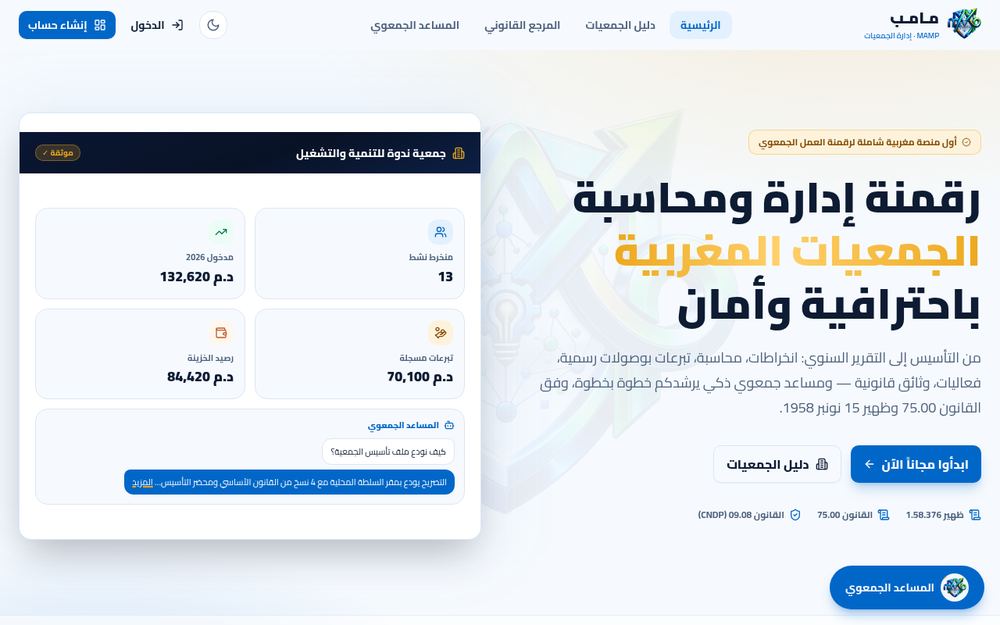
The first comprehensive Moroccan platform for digitizing association work: memberships, accounting, donations, events and official documents — under Law 75.00 and the 1958 Dahir.
 Visit the live site
MAMP is the first comprehensive Moroccan platform for digitizing association work, from founding an association to its annual report: membership management with numbered receipts, categorized accounting with a provisional budget and dual approval, cash and in-kind donation registration, event scheduling with public attendance records, and an official documents archive — plus a digital identity card for every association and a smart association assistant answering from a verified official knowledge base. Every module is built on a real Moroccan legal reference: Law 75.00, the Dahir of 15 November 1958, and Law 09.08 on personal data protection.
MAMP digitizes Moroccan association work with features grounded in the legal and administrative reality:
Every module is built on a real reference: Law 75.00, the 1958 Dahir and Law 09.08 on data protection — not imported solutions that ignore the Moroccan reality.
Categorized income and expenses, a provisional budget, dual approval, and an annual financial report ready to print and present to partners.
Donations and memberships are recorded with numbered official receipts and compliance tracking — the transparency authorities and partners both expect.
A smart assistant that answers procedural and legal questions from a verified official knowledge base — guiding you to the filing step and required documents with precision.
My most research-heavy project: before writing a single screen I read the legal texts and understood the life cycle of an association from founding to general assembly, then built the modules one by one — memberships, accounting, donations, events, documents — and tied them to a five-level permission system and an audit log that records every sensitive operation. The platform is fully Arabic and designed for people with no technical background.
Used to build
Used to run & keep live
Every tool, library and skill I used in this project, explained in plain language: what it is and what it specifically added — no cryptic symbols.
The framework I built the platform with: from the React family used by the world's largest websites — it builds fast interfaces and splits the screen into components that are easy to develop and maintain.
A way of building the interface as small independent components — a button, a card, a table — that assemble like Lego bricks; an error in one component does not break the whole platform, and adding a feature does not mean rebuilding.
A structure that automatically adapts to right-to-left writing: menus, tables and buttons all point the right way — a platform that thinks in Arabic natively, not as a translation.
Passwords are encrypted and sessions are signed and verified by the server on every request — your account is yours alone, even if someone tries to impersonate your privileges.
From platform owner to citizen: five roles checked by the server before any screen is shown — each user sees only what concerns them, with separation of duties guaranteed.
A digital daybook that records every sensitive operation: who did what and when — the cornerstone of trust in association accounting before the general assembly and the authorities.
An open-source Arabic font from Google designed specifically for screens: clear at every size, giving the platform an elegant, readable Arabic identity.
Free global hosting: the platform is distributed across a worldwide network and opens quickly from Morocco and beyond, with an automatic security certificate.
Indicative estimates in Moroccan dirham (MAD); actual costs vary with scope, exact requirements and the services market. My current projects are built and running entirely on free tiers.
This project taught me that programming is a tool, not a goal: the real value came not from the screens but from understanding Moroccan association law and translating the real needs of association actors into simple modules that people with no technical background can use — and that personal data protection (CNDP compliance) is not a technical detail but the cornerstone of trust in any platform that collects people's data.